|
Whether or not there exists a universal now, will be the foundation for argumentation of this paper. The disagreement between the concepts of Einstein's relativity and that of Newton's determinism can be seen in this question... Is there a universal present ? Einstein stated that, "simultaneity is relative. There is no universal present moment at every point of space. Events occurring at spatial separations which cannot be connected by a light signal cannot be assigned a particular chronological order which is the same for all observers in all states of motion. So one of the characteristics of the mental 'now' - that all people everywhere are experiencing the same now - is an unjustified extrapolation. There is no universal now, but only a personal one - a 'here and now'." Is Einstein saying that if they are connected by a light signal - then can there be simultaneous nows at both locations? "events occurring at spatial separations"- under what conditions do events not take place at a spatial separation... Why is this qualifier part of the postulate? Events, signifying two or more, must always not be the same event and therefore must always be at two different locations and have a resultant spatial separation. Whether or not these events can be connected by a light signal has nothing to do with the inability to assign a particular chronological order which is the same for all observers. Again, whether or not these observers are in various states of motion or not, has nothing to do with the inability to determine a particular chronological order which is the same for all observers. When no distinction is made to differentiate the light 'horizon' generated from an event and the actual event itself, then no singular chronological order can be assigned to events which is the same order for all observers. Whether or not location can be connected by a light signal has nothing to do with their simultaneity. It occurs independent of our ability or lack of ability to properly monitor it. Things happen all the time. The universe is in constant motion. Whether or not our definition of time includes its measurement is fundamental in our conceptualization of it. In order to measure time, we have found that the speed of light due to its consistently, is connected conceptually with time. We should not make the intellectual error of equating the two. Time is not light traveling at light speed. Changes in light speed due to observation or due to actual physical speed changes do not change time. It does not take the light signal requirement between locations in order for them to occur at the exact same universal moment. They occur at a distance from one another at the same universal moment. After that precise moment comes the next chronological moment - the universal present that is shared by all of the universe. It all moves forward together constantly being in the present. The fact that light waves from an event continue on into the future is a point that needs some clarification. The event is the event and not the light horizon from the event. The light horizon in effect is its own and distinct "event". Events themselves occur in absolute sequence. From an external view of the universe - watch as things happens at different places at the same time. Not just one location is involved at a given interval. Is he implying that events occurring at spatial separations which can be connected by a light signal can be assigned a particular chronological order which is the same for all observers in all states of motion? When no distinction is made to differentiate the light horizon generated from an event and the actual event itself, then no particular chronological order can be assigned to events which is the same order for all observers. The conclusion that there is no universal present, deduced from the ideas concerning the connection of a light signal to verify some measurement process, is an area that needs to be questioned. Once one buys the premise that there is no universal present, then I have no objections to the limited concepts of relativity. However, I do question this premise, and the conclusions widely accepted about Einstein's relativity. Once you as a scientist cross over this line, then all of the related areas of space and light follow in the footprints of this line of reasoning. Einstein's belief in no universal present has left his logic with paradoxes. - the twin paradox - and situations that defy common sense... If two synchronized atomic clocks are left side by side, they will differ by only a fraction of a second after billions of years. We can check how gravity slows these clocks by putting one of these atomic clocks into an orbital trajectory high above the earth where gravity is weaker and then returning it to the earth and comparing its elapsed time against a clock on earth where the gravity is relatively stronger. The observed time difference between the two clocks agrees with general relativity. In another version of this experiment, one atomic clock is taken from the national bureau of standards in Washington D.C., Near sea level and moved to Denver Colorado. The clock rates differ because of the difference in the gravitational force between the two Locations, and these again accord with general relativity. By a tiny amount, people in Denver actually age more rapidly that those in Washington D.C. Einstein showed that a moving clock marked time more slowly than one at rest. It seems as if the relativity of time poses a paradox - for how can both the passenger on the train and the person on the platform both see each other's watches slow down? By using Einstein's general theory of relativity, which applies to non uniform motions like that of the train, one can demonstrate that the twin on the train has actually aged less. With a different comprehension of "events" and of time and its possible mathematical variations, an entirely different version of reality is possible. * but what is now? There is no such thing in physics; it is not even clear that 'now' can ever be described, let alone explained, in the terms of physics. "a definition of a quantity in physics must provide a set of rules for calculating it in terms of other quantities that can be measured. Length and time are two of the indefinable of mechanics. It has been found possible to express all the quantities of mechanics in terms of only three indefinable. The third may with equal justification, be taken to be mass or force... The rule of measuring an indefinable takes the place of a definition". I believe that we all already know what it means when I use the term the universal present. We each understand this concept and inherently feel this to be the truth, but have been told by Einstein's relativity that there is no universal now. While at my location, I am now experiencing my present. I am aware that I am not the only thing in the universe. I am aware that there exists things in the universe things that are not me. I am aware that in order for these other things to exist that they too must have a present now for them at some point in time. While my particular now is for me, there must indeed be a now for all the other places that exist. The question then is - is it the same now or different now? Einstein suggests that there is a different now. What else then is occurring during the now at his selected locality? What else then exists in his universe when he experiences his unique now? It would seem that the universe does not share his present now and is experiencing some different now. I question his logic. It is this vision of reality that I shall attempt to share. Using this concept of a personal here and now, starting from the instant that you finish this sentence, let an interval of one hour elapse of your personal here and now. While you are experiencing your now during that one hour interval, what else has also experienced that one hour interval? I would suggest that the rest of the universe has moved and therefore experienced its own now. In fact, that its own now must have occurred during the last one hour. This points to a simultaneous occurrence. Einstein in his personal here and now implies that nowhere else is also experiencing the universal present. This restriction of verification of simultaneity by means of measurements of light signals is fundamentally unnecessary. He further complicates the issues of time and simultaneity by ignoring the differences between an "event" and "the light horizon generated by the event". |
|
Instead of using light, sound is perhaps a better phenomena to use as an
example comprehend the universal present. Two singers sing a duet. They
start and finish together. As they are singing they walk away from one
another continuing to sing. When they finish they are too far apart to still
hear one another. They can see each other however, and see that they finish
at the same moment. Next gig for our singers has them singing there songs from their seats in two jetliners. They all well rehearsed in their timing, and complete the song at the same moment this time many, many miles apart. It is however the same moment. They are not connected by a light signal nor other device but do end, at the same universal time. While they were singing, all the other things that took place on the earth or not on the earth, took place during that same time period. If you blink right now as you read this sentence, during that blink, the rest of the universe was still there. Things happened elsewhere during your blink. The two singers are both singing simultaneously. At any selected interval of elapsed time for some particular event, the rest of the universe also shares that interval. |
|
What if we took 100 alarm clocks that we set to go off
every 60 minutes? Starting with the clocks, let 99 people take one clock
each and walk away in random directions. After 60 minutes, would they all
ring simultaneously? What if there was no human or other life form to hear
them - would they still be simultaneous? What if there was no mechanical
sound recording equipment to even verify that any sound occurred - would
they still not ring at the same universal present? One rings at its location
while at the same universal present, the other 99 bells are also ringing.
Does simultaneity need verification in order to occur? Like the tree that
falls in the forest - it is not the perception of a phenomena that
determines whether or not the phenomena occurred.
Einstein seems to imply that simultaneity occurs only if we can verify it through a measurement process. He links the speed of light to time, and uses this equally to conclude that there is no universal present. |
|
Let's try an example...You and your friend ride in your
automobile on your way to the airport. It would seem that you are both
sharing the same present. You arrive at the airport and watch as your
friends plane departs. It would still seem that you are both sharing the
same present. You continue to watch as the plane grows smaller and passes
out of view on its transcontinental flight. When the plane lands - it is
still the same now for you both. It was still the same now when the plane
left your sight. Even if you friend went at light speed or faster, he and
you would continue to share, as everything in every place does...The
universal present. I suggest that Einstein would believe that when the plane
has landed that they no longer share the present universal time. I ask then,
whose time is it that is not in the present universal time. The contention
that time it is only relative to the observer, ignores that fact that (1) it
is the measurement of time (2) that this measurement is of light 'horizons' from
an event and not the actual event. This distinction is important to be made.
If you do not make it, then I understand how you would believe in special
and general relativity and not believe in a universal present.
|
![]() |
|
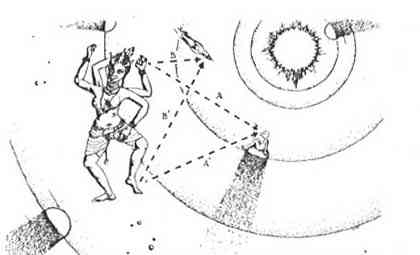
An 11-million-mile tall dancer moves accross the solar system and is viewed from the earth and from a spaceship moving at nearly light velocity relative to the earth. The observers on earth and on the spaceship cannot agree whether the dancer first moved her hand or her foot. Even after taking into account their relative motion and the finite speed of light they cannot agree which event "really" took place first. Unlike the Newtonian concept of time there is no universal time according to the special relativity theory. Heinz R. Pagels says, "or imagine two ordinary sized people, one on the Earth, and the other on a spaceship moving at nearly light speed. Both have front row seats to watch a performance of an eleven-million-mile-tall dancer who moves across the solar system as if it were a stage. It is a marvelous performance; and later they discuss it but cannot agree on what they saw. The viewer on the spaceship says the dancer first moved her arm and then her foot, but the viewer on Earth saw the events in reverse order. Even if they try to analyze the motion of the dancer taking into account the finite speed of light and the motion of the spaceship and the Earth, they cannot agree. The reason is that the second postulate of special relativity -- that the speed of light is constant -- denies the existence of a universal time for all observers. Even the order of events in time can be different for observers moving relative to one another; there is no absolute meaning to such time orderings. |
|
The event itself, is forever in the past. "The 11-million-mile-tall dancer appears to move differently to two different observers, true, but all her events, (not the light horizon from the events), takes place in only one absolute event sequence. She either moved her foot first or she did not. One or two observers cannot verify the absolute sequencing of the actual events. Nevertheless, it still takes place. With additional observer positions this sequence can be determined, as well as the knowledge of where and when the event took place, where the event horizon is now, and where it will be at any time in the future. |
|
"No fixed point in the universe"...Newton. We must be anchored somewhere. There is no heavenly body in our universe that we can use as a stationary reference point. No matter what we may choose as fixed points, we cannot help operating with certain entities which have no absolute significance. As Newton pointed put long ago, it is impossible to tell whether or not a ship is moving through the water by any experiment performed inside the ship. The problem is this. We have the right to set up coordinate axes with the help of which we can orient ourselves in space. We establish a Cartesian frame of axes or a Cartesian reference system. But there is an infinite variety of such systems. We cannot find an absolute center in space, nor are there preferential directions in space which would decide for us how we should orient our coordinate axes. We can set up an infinite variety of coordinate systems by putting the center of the reference system at any point in space and orienting our coordinate axes in any way we like, although keeping them mutually orthogonal. This means that the same physical event can be viewed from an infinity of reference systems, all of them being equally suited to the task of serving as a possible framework for our physical measurements. While we can certainly observe the same physical phenomenon from an infinity of reference systems and thus obtain an infinity of different measurements, it is nevertheless unthinkable that the physical law itself should be influenced by the fact that the observer is in this or that frame of reference. |
|
" There is no difficulty in synchronizing two clocks in the same reference frame: one procedure is to send a light pulse simultaneously to two clocks from a point midway between them, with the two operators setting their clocks to a predetermined time when the pulses arrive. In a thought experiment it is often helpful to imagine a large number of synchronized clocks distributed conveniently in a single frame of reference. Only when a clock is moving relative to a given reference frame do ambiguities of synchronization arise."
University Physics Sears Zemansky Young 1980 page 254 |
![]() |
|
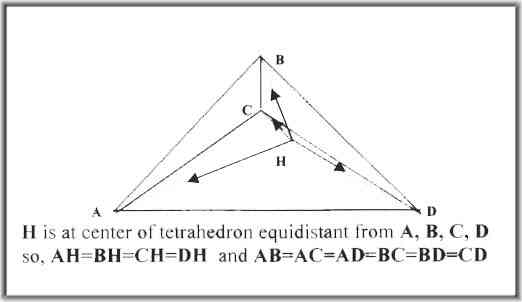
In a thought experiment, place four cesium clocks at the four points of an equilateral
tetrahedron. Let the length of each side be equal to the distance that light travels in one- hundredth of a second (1860 miles) and be permanently physically attached to the center of this tetrahedron and to each other. Send 4 laser signals, from the tetrahedron center to all four locations at the same moment. As each location receives its signal, it records the moment and initializes the clock at its location. Physically, each of these four points is of equal distance from the tetrahedron center, and due to the four light signals travelling at the same speed, it allows these four points to establish a common time frame. These four points, along with their common time frame can be extended to include an entire inter-coordinated system that could encompasses the entire universe. The critical factor is that these four points never change location with respect to each other. |
|
A motor is turned on for 1 minute a light year away. Imagine that on a planet one light year away, a motor is turned on for one minute and then turned off. One year from the event, and after the event, we from our distance, would see the horizon (the motor) come on for one minute and then go off. Elsewhere and at other times, this will be seen to go on and off. We know that the event of the motor being on in reality was only one minute. The perception of that event will last forever. (depending upon the observer's distance from the event.) Once the motor has been turned off, no matter at what speed you could theoretically travel, you could never touch the engine while it is / was on. ![]() |
|
Heisenberg stated that it was impossible to know both a particle's location as well as its momentum at a given moment. Since we must be an observer, we must therefore be at some distance of separation from the event. That distance cannot be traversed instantaneously by light (or even at a billion times the speed of light), without some amount of time elapsing between the occurrence of the event and the perception of that event by an observer. No matter how close that the observer is from the event, the observer can NEVER know what is happening at that exact site of that event (or at any other location other than there own specific location). The idea of knowing a particle's position and momentum is an interesting problem. How could we ever know the exact position of anything in the present? Either you are the event ... then you have nowhere to use as a reference system, or you are not the event - and you are separated from the event.... you cannot know the present. You obviously could not be separated any distance from the event of particle in question, since any distance between you and the event would require some time to expire. Therefore, you would not be able to know what occurs at the event when it occurs since you are not there. If somehow, we the observer, could be magically miniaturized and were able to actually, physically stand on a particle, then your head and therefore your eyes are still not at the particle surface and therefore are still a separated distance from the particle. If you then got down on your knees and held your head barely off the surface - still a distance of separation. Should you then put your eyeball in direct contact with the surface, then you still could not observe the eventat the moment of the event's occurrence. Additionally, you would be on the surface of a sphere and not at some theoretical point. This sphere has dimension. Should your eyeball be at the surface of a sphere, then you would be unable to detect what was occurring on the opposite side. In fact, at best , you could only detect a single point of the sphere... the one to which you eyeball was touching. Even that single point, since it has no distance of separation, cannot be observed since your eyeball is actually the event in this case. To continue, when does it officially become an observation? When a light signal reaches one of your eyes, or when it has reached both of your eyes, or when it has traveled from your eyes to your brain, or when your brain has been able to comprehend what it has seen? What exactly do we mean by an observation? It would seem almost self evident that when we are separated from some specific point / event at the moment of its occurrence, at its unique location... that we cannot know what occurs at that exact event's moment in time. |
|
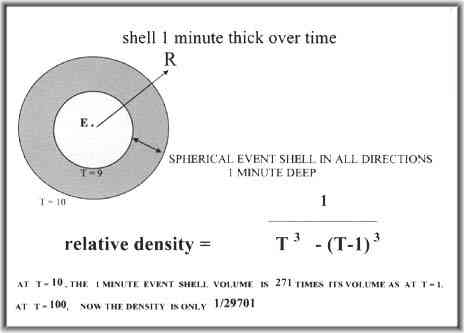
When we observe the crab nebula, for example, we are seeing it not as it is
now, but how it was 4000 years ago.
In the elapsing of 1 minute, a star 10,000 light years away from earth
explodes and it no longer, after the explosion, is the same. It actually
ceases to exist. 5000 years later, after this explosion, there still exists
the light horizon that came from event. This spherical shell is as wide as the
event duration; the distance that light travels in 1 minute. Due to the
explosion, more light was produced than at previous normal by the star. This
1 minute deep spherical shell of light continues to travel ( as seen in #8 ) as the star
itself (which for purposes of understanding could be considered to be the
event) has been non-existent for quite some years. When this band of light
eventually reaches the earth, we see an increase of light of some 60 second
duration and then that burst of light goes out.
Has the event has taken place? If you say no, the event has not taken place - then no event could ever occur because the light horizon eventually continues on past virtually every other point in the universe. At what particular point does the event become official? If you say yes - then, the event has taken place -then you deny the fact that the 60 second light horizon continues on. The idea that the event has taken place relevant to you, is not the question. (of course, relevant to you, the event is over). This is logic that may seem silly or questionable due to the current conceptions regarding relativistic theory. It is a distinction that need be made for our current understanding of the word "event". In the above example of the explosion of a star, if we choose the "event", to be the existence of the star, then logically, when the star has ceased to exist, the "event" has taken place. The inclusion of the light horizon generated from the stars explosion in terms of the "event", is not only confusing but is where much of the misunderstanding regarding the deductions and conclusions of relativity. The star and the 60 second light horizon are two completely different phenomena. They are connected by cause and effect, they are not the same event. When the star ceases to be, the event has taken place. When you do not make this distinction for the "event", then (1) there is no universal present (2) there is no absolute sequence of events (3) there is no absolute distance (4) the passage of time is not the same under varying conditions - someone or something can age faster than another. When you do make this distinction for the "event", then (1) there is a universal present (2) there is an absolute sequence of events as well as a perceived sequence of the light horizons from events (3) there is an absolute distance as well as a perceived distance (4) the passage of time is the same under varying conditions - someone or something does not, nor cannot under any condition age any faster or slower than anything else in the universe in terms of time. |
|
Time is not light related. What if the universe had no light ?
Would time itself disappear ? The light-less universe has continual changes in
the locations of its masses and therefore inherently has time. Time is a
function of change and is not a function of either the speed of light nor
the function of the entity of light. Time must be associated with some
physical change - some physical phenomena. The universe changes physically
and therefore time is relevant; relevant in the sense that it is associated
with some physical change. Think of the universe as solely a combination of only two things. One of these two things is matter. The second thing to be considered is the locations of this matter. That is to say that, time, light, energy, charge, field, magnetism., gravity, radiation, nuclear structure, nuclear orbital shapes, antimatter, and everything else is but a consequence of these two sole components of the universe. These indivisible pieces are all identical to one another. There is no corresponding set of particles that differ in charge from one another at this unitary level. Charge is a consequence of matter agglomerating. This agglomerating has already taken place at the level of protons, neutrons and even electrons. unlike what we have all been taught. Imagine if even light quanta were actually not quanta at all, but rather were themselves agglomeration of these unitary spheres. Even this accumulation of particles are still far too small to be individually discernible. Too small for mass comparisons... could "quanta" as a spherical entity be able to exhibit a wavelength ? |
The contents of this article are © Copyright Steve Waterman or a third party contributer where indicated. You may print or save an electronic copy of parts of this article for your own personal use. Permission must be sought for any other use.
|