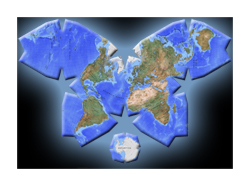
"The use of interrupts reduces distortion for the production of globes. Minimal distortion is vital for production purposes; hence gore maps are used, where the world is divided in for instance twelve gores. Goode's homolosine (1923) is an equal area projection, composed of twelves regions to form six lobes interrupted, with interupts through the ocean. The production on the Earth on unfolded polyhedra instead of rectangles and ellipses, is an old idea going back to Da Vinci and Durer. All regular polyhedra have been proposed as suitable candidates. Some examples are Cahill's Butterfly map (1909 octahedron) and the Dymaxion Map of Buckminster Fuller, who used the cuboctahedron (1946) and the icosahedron (1954). Steve Waterman has developed an appealing polyhedral map, based on sphere packing."
Barbara Hall
Associate Director, Alumni Relations & Hendrickson Institute for Ethical Leadership
Saint Mary's University of Minnesota
Every year, we look for a visual to tie "the world" to the Hendrickson Institute for Ethical Leadership Forum at Saint Mary's University of Minnesota. Our topics are of global importance and maps reinforce that idea. They're also a great ice breaker - strangers talk about where they've been and, in this case, how amazing the Waterman Butterfly view of the world is. Since it's based on satellite images, it's very accurate and both the topography and geography are very clear - and sometimes startling. The only downfall is that it's hard to keep them - people want to take them home and frame them. Thank you, Steve, for making this resource available.